
2701. The Political Economy of Cruelty: Some Elements
Pierre Lemieux explores the relationship between individual and governmental cruelty, analyzing how incentives and public choice contribute to cruel policies and behaviors.
your daily dose of economic commentary
Pierre Lemieux explores the relationship between individual and governmental cruelty, analyzing how incentives and public choice contribute to cruel policies and behaviors.

An argument that explores the relationship between cost-minimizing techniques, net output, and the concepts of extensive and intensive rent in economic analysis.

The post discusses Chloe Malle's promotion to editor of American Vogue and her ongoing reporting relationship with Anna Wintour.

Bill McBride discusses a 0.1% decrease in construction spending in July 2025, highlighting trends in private and public construction investments.
Alex Tabarrok discusses the Taiping Rebellion's significance, its Christian roots, and its impact on China's political landscape during the 19th century.

An argument that the Trump administration's illegal tariffs and diplomatic blunders reveal its incompetence and vanity, undermining the U.S.'s global standing and economic integrity.

The post discusses the decline in the Freddie Mac House Price Index for July, noting a year-over-year increase and highlighting regional variations in home prices.

Alina Selyukh discusses Kraft Heinz's decision to split after a challenging decade following its merger orchestrated by Warren Buffett.

Jennifer Ludden discusses Utah's efforts to increase starter home construction amid concerns that young people are unable to build wealth in a high-cost housing market.
Menzie Chinn discusses advancements in medical science since 1900 and critiques the nostalgic view of the past, particularly in relation to Donald Trump's policies.

Scott Cunningham shares his experiences of moving to Boston, attending his first Red Sox game, and preparing for the upcoming semester at Harvard.

The post explores the reasons behind Americans working more hours than their European counterparts, highlighting historical, economic, and social factors influencing labor practices.

The post explores Texas Instruments' dominance in the graphing calculator market, attributing it to historical advantages, market power, and strategic relationships with educational institutions.

Noah Smith explains his reasons for leaving Bloomberg, including health issues, increased bureaucracy, and a significant incident involving the Chinese Communist Party.

Active single-family housing inventory decreased slightly week-over-week but shows significant annual increases, with comparisons to previous years indicating a trend toward 2019 levels.

The post discusses the impact of Trump's actions on federal employee unions, highlighting the loss of collective bargaining rights and ongoing legal challenges.
Tyler Cowen discusses stock valuations, corporate taxes, and market predictions regarding inflation and political outcomes, emphasizing the implications for taxpayers and democracy.
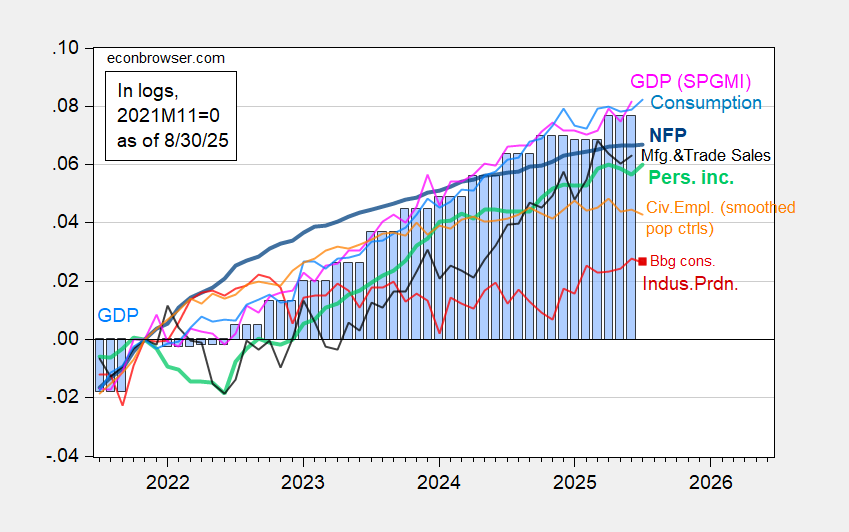
Economic indicators show a mixed picture, with several metrics below recent peaks, yet overall growth persists in the economy.
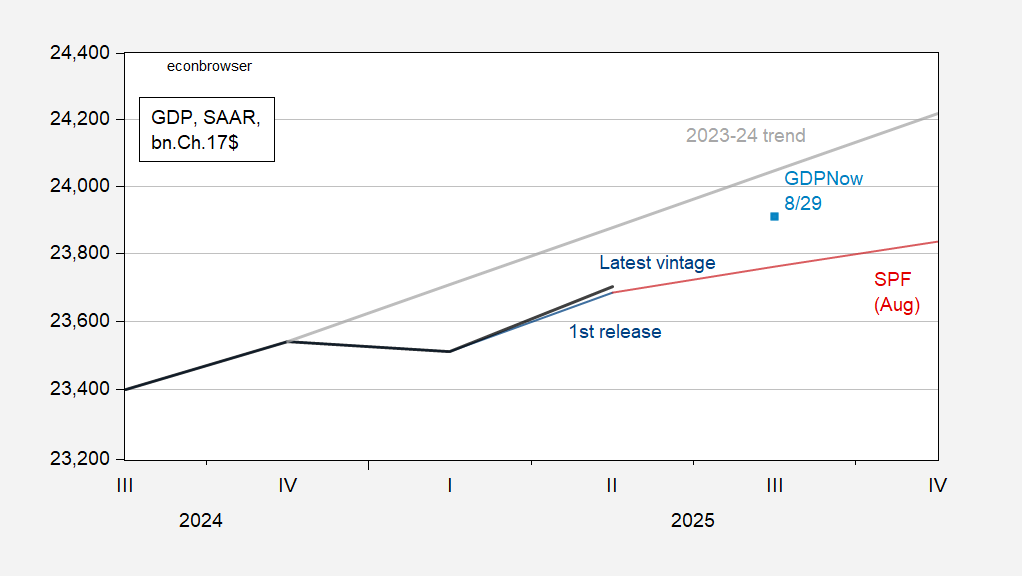
Menzie Chinn discusses the deceleration of aggregate demand despite upward revisions in GDP growth for Q2 and Q3.

An argument that explores the disconnect between the beliefs of woke elites and their actions, particularly regarding socioeconomic policies and the shifting political allegiance of marginalized groups.